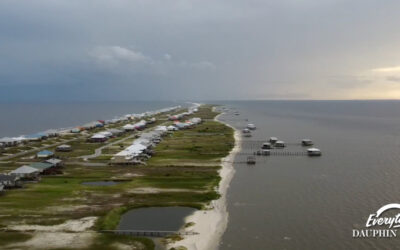
For more than 60 years, the Dauphin Island Bridge has served as the vital lifeline connecting Alabama’s barrier island paradise to the mainland. This engineering marvel, officially known as the Gordon Persons Bridge, spans 3.5 miles across the Mississippi Sound and has weathered hurricanes, witnessed historical moments, and carried millions of visitors to the island’s pristine beaches. The story of this bridge is one of determination, reconstruction, and the ongoing challenge of maintaining infrastructure in one of America’s most hurricane-prone regions.
Before the Bridge: Island Isolation
Prior to 1955, reaching Dauphin Island required either a boat journey or a considerably longer route through Mississippi. The island’s strategic location at the mouth of Mobile Bay had long been recognized – from French colonial times through the Civil War’s Battle of Mobile Bay – but its isolation limited development and access for most of the 20th century’s first half.
The island’s permanent population in the early 1950s numbered fewer than 300 residents, mostly fishing families and Fort Gaines personnel. Summer visitors who made the effort to reach the island by ferry often stayed for weeks, as the journey itself was an undertaking. The Mobile Chamber of Commerce and local politicians recognized that improved access could transform Dauphin Island into a major tourist destination while preserving its role as guardian of Mobile Bay.
The Original Span (1955)
Construction of the first Dauphin Island Bridge began in 1953 under the administration of Alabama Governor Gordon Persons, for whom the bridge would later be named. The $5.5 million project (approximately $60 million in 2024 dollars) represented a significant investment in South Alabama’s future, funded through a combination of state bonds and federal highway funds.
The original design featured a two-lane concrete and steel structure rising 85 feet above mean high water at its highest point to allow ship passage into Mobile Bay. Engineers from the Alabama State Highway Department worked with Hardaway Construction Company to complete what was then considered a remarkable feat of engineering, driving pilings deep into the sandy bottom of the Mississippi Sound to support the massive structure.
On July 2, 1955, Governor Persons cut the ribbon to officially open the bridge, declaring it “Alabama’s window to the Gulf of Mexico.” The Mobile Press-Register reported that over 5,000 vehicles crossed the bridge on its first weekend, with visitors eager to explore the newly accessible island. The bridge initially operated as a toll facility, charging $1.00 per vehicle (roughly $11 today) to recoup construction costs.
Hurricane Frederic and the First Rebuild (1979-1982)
The bridge’s first major test came on September 12, 1979, when Hurricane Frederic made landfall near the Alabama-Mississippi border with sustained winds of 130 mph. The Category 3 storm’s massive surge and waves destroyed the bridge’s center span, leaving twisted steel and broken concrete where the roadway once stood. Aerial photographs from the aftermath showed a gap of nearly 200 feet in the bridge, effectively cutting off the island’s 1,500 residents from the mainland.
The destruction prompted serious debate about whether to rebuild. Some state officials questioned the wisdom of reconstructing expensive infrastructure in such a vulnerable location. However, Dauphin Island’s growing importance as a tourist destination and its role in Mobile County’s economy ultimately swayed the decision. The island had grown significantly since the bridge’s opening, with the establishment of the Dauphin Island Sea Lab in 1971 and increasing property development.
Reconstruction began in 1980 with a modified design intended to better withstand future storms. Engineers incorporated lessons learned from Frederic, including stronger pilings, improved joint connections, and a higher deck elevation in critical sections. The new $33 million bridge opened to traffic on December 15, 1982, featuring the same two-lane configuration but with enhanced structural resilience.
The Modern Era and Hurricane Ivan (2004)
For over two decades, the rebuilt bridge served its purpose well, carrying increasing traffic as Dauphin Island evolved into a year-round destination. By 2004, annual crossings exceeded 500,000 vehicles, supporting a thriving tourism industry and a permanent population approaching 1,300 residents.
Hurricane Ivan’s arrival on September 16, 2004, marked another pivotal moment in the bridge’s history. The Category 3 hurricane’s 10-15 foot storm surge severely damaged several sections of the bridge, though it didn’t cause the catastrophic failure seen with Frederic. Multiple spans shifted off their supports, concrete decking cracked, and several support pilings sustained significant damage. While the bridge didn’t collapse entirely, it required complete closure for extensive repairs.
The Alabama Department of Transportation (ALDOT) fast-tracked emergency repairs, understanding the economic impact on both the island and Mobile County. Working around the clock, construction crews completed temporary fixes within six weeks, allowing limited traffic flow. Permanent repairs, costing $26 million, continued for several months, with the bridge fully operational by summer 2005.
Hurricane Katrina and Continuous Challenges (2005-Present)
Less than a year after Ivan’s repairs were completed, Hurricane Katrina struck on August 29, 2005. Though Katrina made landfall in Mississippi, its massive size and storm surge caused additional damage to the recently repaired bridge. Several expansion joints failed, and scouring around the bridge pilings required immediate attention to prevent structural failure.
The quick succession of major hurricanes prompted ALDOT to reassess the bridge’s long-term viability. A 2006 engineering study recommended $55 million in improvements, including:
- Reinforcement of all pilings with additional concrete jacketing
- Installation of new hurricane-resistant rail systems
- Improved expansion joints designed to handle extreme lateral forces
- Advanced monitoring systems to detect structural issues early
These improvements, completed between 2007 and 2010, significantly enhanced the bridge’s resilience. The monitoring system, featuring strain gauges and accelerometers, provides real-time data on the bridge’s structural health, allowing engineers to identify potential issues before they become critical.
Economic Impact and Daily Life
Today’s Dauphin Island Bridge carries far more than vehicles – it bears the economic lifeblood of South Mobile County’s coastal economy. A 2019 economic impact study found that the bridge facilitates:
- Over $150 million in annual tourism revenue
- Support for 2,000+ direct and indirect jobs
- Access for 25,000+ participants in the annual Deep Sea Fishing Rodeo
- Year-round access for researchers at the Dauphin Island Sea Lab
- Critical evacuation routes during hurricane threats
The bridge sees its heaviest use during summer weekends, with traffic often backing up for miles as beachgoers head to the island. Local businesses have adapted to this rhythm, with many establishments timing deliveries and supply runs for early morning hours to avoid congestion.
Maintenance and Future Considerations
Maintaining a major bridge in the Gulf Coast’s harsh environment requires constant vigilance. Salt spray accelerates corrosion of steel components, requiring regular painting and protective coating applications. ALDOT inspects the bridge bi-annually, with underwater inspections of the pilings conducted every five years.
The bridge’s maintenance costs average $2-3 million annually, not including major repairs after storm events. This ongoing expense has prompted discussions about the bridge’s long-term future. Options under consideration include:
- Construction of a parallel span to provide redundancy and increase capacity
- A complete replacement with a modern cable-stayed or suspension design
- Conversion to a causeway design similar to the Mobile Bay Causeway
- Implementation of tolling to fund maintenance and eventual replacement
Engineering Marvel in a Challenging Environment
The Dauphin Island Bridge represents more than a mere transportation link – it embodies human determination to connect communities despite nature’s challenges. The bridge must withstand:
- Hurricane-force winds exceeding 150 mph
- Storm surges that can reach 15-20 feet
- Constant salt water exposure causing corrosion
- Ship impacts from vessels navigating Mobile Bay
- Extreme temperature variations affecting expansion joints
Modern engineering solutions incorporated into the bridge include:
Flexible Design Elements: The bridge’s expansion joints and bearing systems allow for movement during extreme weather, preventing catastrophic failure from rigid resistance to natural forces.
Deep Foundation System: Pilings extend up to 90 feet below the seafloor, anchoring into stable geological layers that resist scour and lateral forces.
Redundant Structural Systems: Multiple load paths ensure that damage to one component doesn’t result in complete failure, a lesson learned from previous hurricanes.
Cultural Significance and Local Identity
For Dauphin Island residents, the bridge represents more than infrastructure – it’s a symbol of resilience and connection. Local artists have painted the bridge countless times, capturing its graceful arc against Gulf sunsets. The bridge features prominently in island folklore, with stories of record catches made from its fishing catwalks and proposals offered at its highest point.
The phrase “going over the bridge” has entered local vernacular as shorthand for escaping to island life. For many Mobile County residents, crossing the bridge signals the beginning of vacation, a transition from mainland responsibilities to island time.
Looking Ahead: The Next Chapter
As climate change intensifies Gulf storms and sea levels continue rising, the Dauphin Island Bridge faces mounting challenges. ALDOT’s 2023 infrastructure assessment rated the bridge as “functionally adequate but aging,” noting that major rehabilitation or replacement will be necessary within the next 15-20 years.
Proposed designs for a replacement bridge incorporate cutting-edge resilience features:
- Elevated approaches reducing surge vulnerability
- Smart materials that self-report structural stress
- Modular construction allowing rapid post-storm repairs
- Integrated multimodal paths for bicycles and pedestrians
The estimated cost for a new bridge exceeds $250 million, prompting ongoing debates about funding mechanisms and design priorities.
More Than Steel and Concrete
The Dauphin Island Bridge stands as testament to Alabama’s commitment to its coastal communities. Through hurricanes, reconstructions, and constant maintenance challenges, the bridge has evolved from a simple two-lane crossing to a sophisticated piece of infrastructure embodying decades of engineering lessons.
For the thousands who cross it annually, the bridge offers more than passage – it provides access to natural beauty, recreational opportunities, and a unique island culture. As discussions continue about its future, one thing remains certain: the connection between Dauphin Island and mainland Alabama, first established in 1955, will endure, adapting to meet whatever challenges nature presents.
Whether you’re a first-time visitor catching your initial glimpse of the Gulf or a longtime resident making your thousandth crossing, the Dauphin Island Bridge remains what Governor Persons envisioned nearly 70 years ago – Alabama’s gateway to the Gulf, standing resilient against time and tide.